For those of you who were not able to attend Michael Carlson’s presentation at the 50th Annual Real Estate Journalism Conference in New Orleans in 2016 here is a summary of the discussion on Net Zero building design.
Question: Why do something different? We are all pretty good at what we do. Why change?
Answer: When the risk of NOT changing exceeds the risks of change. This is where we are today, whether we are comfortable with that or not. Change involves risk. Change creates tension.

If you do not yet sense an urgency for change, you will soon. There is now and will continue to be market resistance. Market can only transform so fast without a crisis. The sweet spot for now may be where both sides are angry: The market is uncomfortable with the required rate of change, and those that understand the current and pending risks are angry that change is not happening fast enough.
Currently we face many threats and opportunities
• Climate Change: The Planet is stressed
• Carbon
• Population Increase: 7+ billion people now
• Geo-Political Risk
• Cost of energy
• Government taking Action (codes)
• Long term performance
• Eco Systems provide basic services
REWARDS are out there to be realized
• Be proactive, not reactive. (You are either at the table or on the menu!)
• Get out in front of regulations
• Increase profits
• Access to natural resources
• Access to Capital
• Efficient management of resources
Climate change is like the internet. It arrives one day, it gets bigger every year, and it never goes away. You need to learn to make money from it, or get eaten for lunch.
2030 Architecture
Net Zero Energy is a path. The path began with the establishment of a base line of energy use/efficiency standard set in 2003. The path from 2003 until 2030 is to incrementally reduce the energy use of buildings, shifting to the use of fossil free energy, and having all new buildings be carbon neutral by 2030. Energy Codes have improved about 40% since 1985, and within that the improvement has been about 36% since 2003. So codes have taken us about 1/3 of the way to our 2030 goal already. But in 2019 we are about 60% though the time line of 2003-2030.
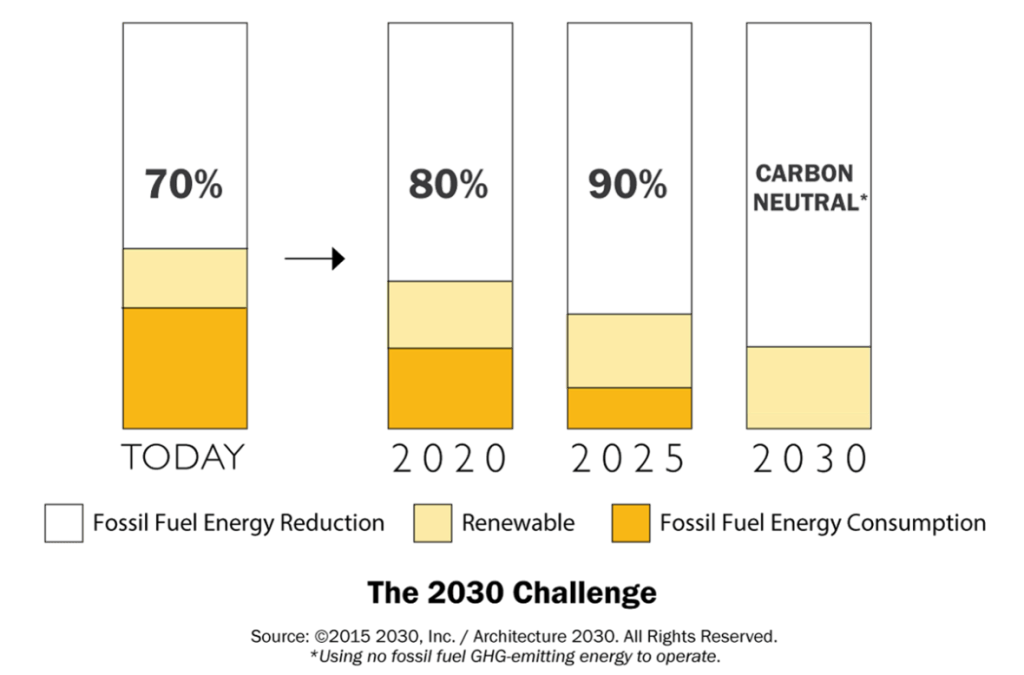
The graphic below shows the steady improvement of the Energy Codes over the past 30 years. Including LEED versions V1.0-V4.0

(Graphic above provided by US Green Building Council)
LEED will always try to stay ahead of the building codes. The graphic below shows this pretty clearly. As the codes improve, LEED changes it base line criteria to be more stringent to stay ahead of the codes. Green Building codes and green rating system standards are gradually incorporated into the code requirements for all buildings. Eventually (ideally by 2030) the code will require zero impact buildings, which in the case of energy use, will be Net Zero buildings that have zero carbon impact to the environment. Currently, we are still doing buildings that have less negative impact. We need to transition from doing “less bad” and accelerate towards buildings that have a positive impact on the environment.
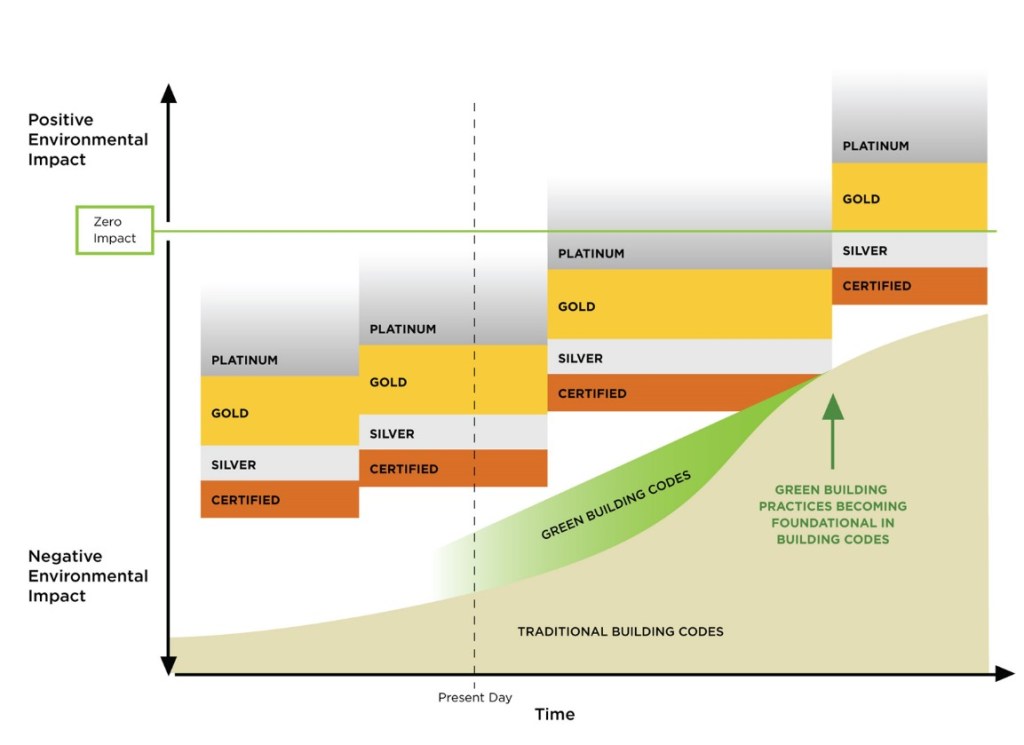
Graphic provided by US Green Building Council
How does one achieve NET ZERO? (Carbon Neutral Building)
Step 1:
Design a building that uses 60%-70%-80% less energy than a code compliant building.
Step 2:
Provide fossil free fuel energy for the remaining energy needs.
Simple, right? The playbook to get to net zero is widely accepted and a proven, successful approach. But reducing energy consumption by 70-80% and maintaining comfort is not accomplished by simply tweaking the way we have always designed and built buildings. A bit more efficiency in heating and cooling systems, or some more insulation does not get us there. A fully integrated, thoughtful and intentional design solution does.
RESOURCES
 Michael R. Carlson, Architect